how to appeal an Amazon account suspension in 2026 | Updated October 2026 | 11 min read | The Appeal Guru Editorial Team
To appeal an Amazon account suspension in 2026, the process involves several critical steps: first, **identify the exact policy violation** named in your Performance Notification. Next, **gather verifiable evidence** that directly addresses the issue. Finally, **submit a Plan of Action (POA)** through Seller Central that clearly outlines the root cause of the problem, the corrective actions you have already taken, and the preventive measures you have implemented, all structured according to Amazon’s specific requirements. This guide walks you through every stage of that process, from diagnosing your suspension type to deciding when professional help is worth the investment. Amazon’s enforcement systems have changed significantly this year, and sellers who treat the appeal like a form letter rather than a documented dispute are far more likely to see their first submission denied.
Suspensions are no longer rare, isolated events. Industry data shows that 14% of Amazon seller accounts experienced temporary or full suspensions in Q1 2025, up from 11% in 2024, and the trend has continued into 2026 as Amazon expands automated detection. Understanding the mechanics of the appeal process before you’re suspended, or immediately after you are, is the **single biggest factor** separating a 48-hour reinstatement from a multi-month nightmare.
A suspended Amazon account is not a dead account, it’s an unanswered question. Amazon’s Seller Performance team is not asking “should this seller be punished,” it’s asking “has this seller proven the problem is solved.” Every appeal that fails, fails because it answers the wrong question.
How to appeal an Amazon account suspension in 2026: the step-by-step process
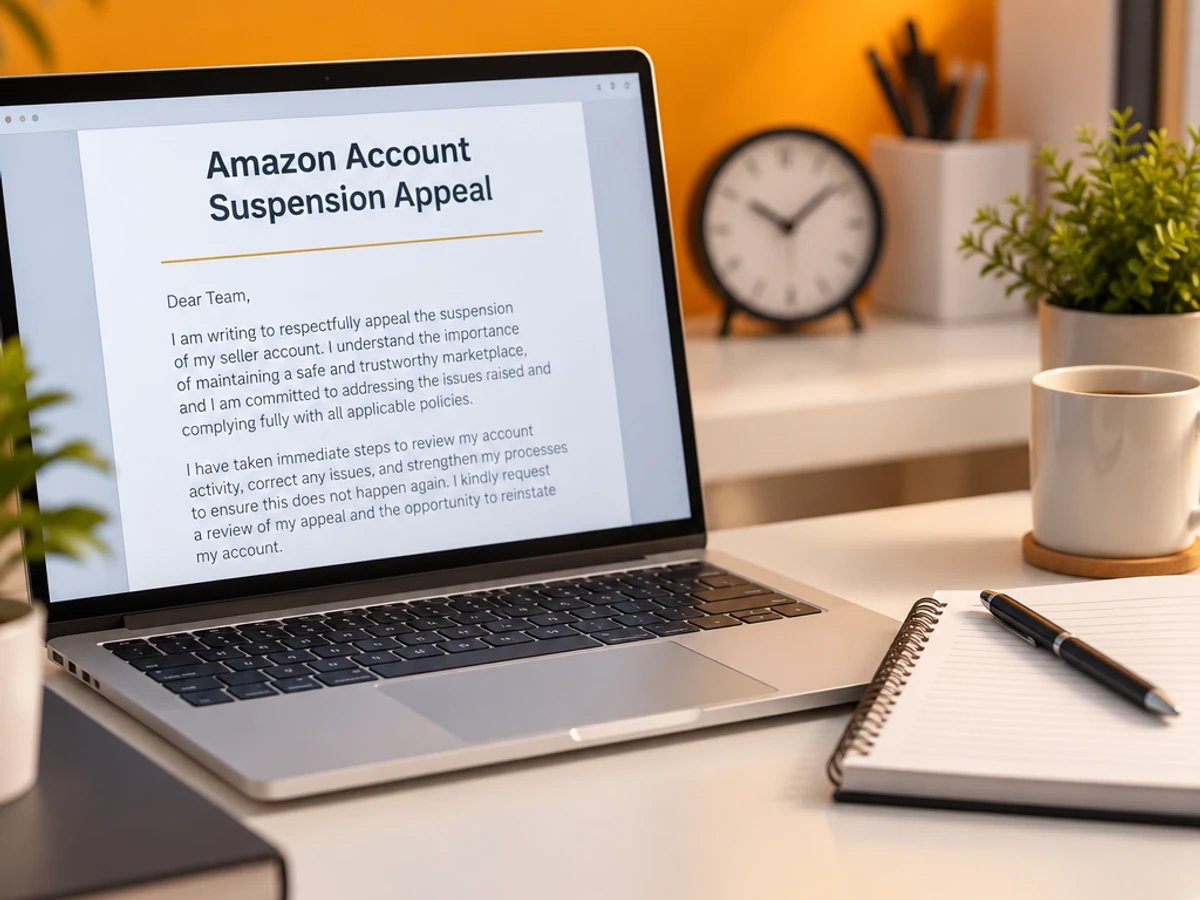
Appealing an Amazon suspension in 2026 means submitting a structured Plan of Action (POA) through Seller Central that is **matched precisely to the policy category Amazon cited**, supported by verifiable documentation, not a generic apology letter. Your POA must include the root cause of the issue, what corrective actions you’ve taken, and what preventive measures you’ve implemented, and each claim needs attached proof. Amazon’s review systems in 2026 are faster and less forgiving of vague language than in previous years.
The five-step appeal sequence
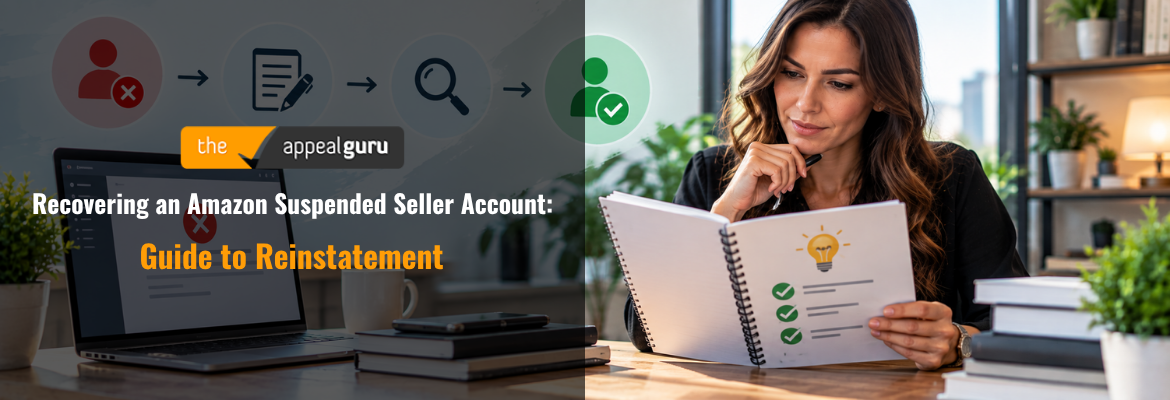
- Read the Performance Notification word for word: Identify the exact policy cited (authenticity, IP complaint, related accounts, Section 3, or a performance metric) because a mismatched appeal is an instant rejection.
- Pull your Account Health data: Cross-reference the notice against your dashboard at sellercentral.amazon.com to confirm which metric, ASIN, or complaint triggered the action.
- Collect verifiable evidence: Gather supplier invoices, shipping records, refund confirmations, or compliance certificates that directly prove the corrective steps you’ve taken.
- Draft the Plan of Action: Structure it around root cause, completed corrective actions (past tense), and documented preventive controls, never a vague promise to “do better.”
- Submit and monitor: File through the appeal link in Seller Central and respond to any follow-up requests within hours, not days.
A well-structured Plan of Action can move quickly through review, while a vague, emotional appeal can extend the process by weeks. The difference almost always comes down to **specificity and documentation**, not sympathy.
Key Takeaway: Winning an Amazon suspension appeal in 2026 depends less on how sorry you sound and more on how precisely your Plan of Action maps to the exact policy violation Amazon cited, backed by dated, verifiable evidence. For deeper context, see Amazon Suspension Appeal Services, seller suspension letter ….
Why does Amazon suspend seller accounts in 2026?
Amazon suspends seller accounts for a defined set of policy and performance reasons, and in 2026 its automated systems flag violations faster and at lower confidence thresholds than in prior years. Knowing which category your suspension falls under **determines exactly what evidence your appeal needs to include**.
Performance metric breaches
Amazon tracks a small set of metrics with published thresholds, and breaching them triggers automatic warnings or suspensions well before a human reviewer gets involved.
| Metric | Suspension Threshold | Primary Causes | Typical Fix Time |
|---|---|---|---|
| Order Defect Rate (ODR) | Fixed under 1% | Negative feedback, A-to-Z claims, chargebacks | 1-4 weeks |
| Late Shipment Rate (LSR) | Less than 4% | Warehouse delays, courier failures | Days to 2 weeks |
| On-Time Delivery Rate (OTDR) | Varies by category | Fulfillment or carrier disruption | 1-3 weeks |
| Valid Tracking Rate (VTR) | Category-dependent | Missing or mismatched tracking data | Days to 2 weeks |
Policy and complaint-driven suspensions
- Authenticity complaints: Triggered when a buyer or brand owner alleges a product is not genuine, often without having purchased it first.
- Intellectual property (IP) complaints: Filed by rights owners and among the hardest categories to reverse without direct rights-owner retraction or clear licensing proof.
- Related account flags: Triggered by shared devices, IP addresses, payment methods, or business information linked to a previously suspended account.
- Section 3 closures: Amazon’s most severe enforcement track, reserved for alleged fraudulent, deceptive, or illegal conduct.
- Voice of the Customer (VoC) issues: In 2025 and into 2026, Amazon has used VoC data more aggressively, with negative buyer feedback and high return rates feeding directly into account-level warnings.
According to industry analysis of 2025-2026 enforcement trends, **Section 3 violations and IP complaints** together account for roughly 45 percent of permanent account closures, making them the two categories where professional appeal support most often changes the outcome.
Key Takeaway: Your appeal strategy must match your suspension category exactly; a performance-metric Plan of Action will not satisfy an authenticity or Section 3 reviewer, and vice versa. Understanding the specific reason for your suspension is the foundation for everything that follows. For deeper context, see FTC Sues Amazon for Illegally Maintaining Monopoly Power.
How do you write a Plan of Action Amazon will actually accept in 2026?
A Plan of Action that Amazon accepts in 2026 follows a strict three-part structure: root cause, corrective actions already completed, and preventive measures with ownership attached. Amazon’s review process, increasingly assisted by automated triage, **rejects generic or templated language within minutes**, so specificity and evidence matter more than length.
The three required components
- Root cause analysis: State precisely what caused the violation, tied to an operational factor like supplier vetting, listing QA, or shipping control, not a generic acknowledgment.
- Corrective actions taken: Describe what has already been done in past tense; use past tense to show these actions are complete, not planned, and include dates and documentation.
- Preventive measures: Explain the systemic changes installed to ensure recurrence is blocked, such as new SOPs, incoming inspections, or supplier approval workflows.
Common mistakes that trigger rejection
Even experienced sellers fall into the same traps when drafting their own appeal, and the cost of a rejected first attempt is often a slower second review.
- Vague reassurances: Phrases like “it won’t happen again” without a documented mechanism are an instant red flag to reviewers.
- Copy-paste templates: Copying a generic template without tailoring it to your specific violation is one of the most common reasons appeals fail.
- Rapid resubmission: Submitting multiple appeals in quick succession without meaningful changes signals to Amazon that the seller hasn’t actually fixed anything.
- Formatting errors: Amazon has rejected appeals over improperly formatted supporting documentation even when the written case itself was strong.
Every document has to meet Amazon’s formatting requirements, and cases have been rejected purely because the supporting documentation didn’t meet that bar, even when the appeal itself was flawless.
This is where The Appeal Guru adds value for sellers who feel out of their depth. The Appeal Guru believes every honest seller deserves a fair chance to operate and grow their business, and its team builds **bespoke Plans of Action, verifies invoices, and structures evidence** the way Amazon’s reviewers expect to see it, rather than relying on recycled templates.
Key Takeaway: A Plan of Action succeeds or fails on three specific elements: root cause, completed corrective action, and documented prevention. Skipping or softening any one of them is the most common reason first appeals are denied. Getting this right the first time saves weeks of waiting. For deeper context, see How to Write an Amazon Plan of Action That Actually Gets ….
What happens after you submit your Amazon suspension appeal?
Once a Plan of Action is submitted, Amazon routes it to Seller Performance for review, and the outcome generally falls into one of three paths: reinstatement, a request for more information, or denial with the option to revise and resubmit. Understanding this timeline helps sellers plan cash flow and **avoid panic-driven resubmissions** that can slow the process further.
Typical appeal timeline by suspension type
| Suspension Type | First Response Window | Typical Resolution Time | Escalation Path if Denied |
|---|---|---|---|
| Performance metric breach | 24-72 hours | 24-48 hours to 2 weeks | Revised POA with updated metrics evidence |
| Authenticity complaint | 2-5 days | 1-4 weeks | Supplier invoices, rights-owner retraction |
| Related account flag | 3-7 days | 2-6 weeks | Business verification documents, affidavit |
| Section 3 closure | 5-10 days | Weeks to months | Executive escalation or legal review |
Why timelines vary so widely
Resolution speed depends on three factors working together, and sellers who understand them can set realistic expectations rather than assuming every case resolves in 48 hours.
- Severity of the violation: A late shipment rate issue resolves faster than a counterfeit complaint, since the evidence bar is lower.
- Quality of the appeal: A well-structured, evidence-backed Plan of Action moves through review far faster than one requiring multiple rounds of clarification.
- Account history: First-time issues are evaluated differently than repeat violations, which face stricter scrutiny on each resubmission.
- Payout holds: Reimbursement and payout holds often outlast the reinstatement itself by 30 to 90 days, so cash flow planning matters just as much as the appeal.
Key Takeaway: Reinstatement timing is not random; it’s a direct function of violation severity, appeal quality, and account history. Sellers who document corrective action thoroughly on the first attempt consistently see faster outcomes than those who resubmit repeatedly. This distinction between reinstatement and payout release is critical to understand before you’re in crisis mode. For deeper context, see Amazon Account Appeals – Step-by-Step Guide to ….
Should you appeal an Amazon suspension yourself or get professional help?
Many sellers can successfully appeal straightforward, first-time performance suspensions on their own, but complex cases involving authenticity complaints, related account flags, or Section 3 closures carry a much higher risk of denial without specialized experience. The decision often comes down to **how much revenue is frozen** and how confident you are in building evidence-backed documentation under pressure.
When DIY appeals make sense
- First-time, low-severity metric breaches: A single late shipment spike or a minor ODR breach with a clear, documentable cause is often manageable without outside help.
- Clear-cut operational errors: Cases where the root cause is obvious and the fix is simple, like correcting one mislabeled listing, rarely require escalation.
When professional support changes the outcome
- Repeat denials: If a self-submitted appeal has already been rejected once or twice, the account history now requires a stronger, more precisely documented case.
- Authenticity or IP complaints: These require invoice verification and rights-owner communication that benefit from specialized experience.
- Section 3 closures: The most severe enforcement track, where errors in documentation or tone can permanently close escalation options.
- High-value frozen payouts: When tens of thousands of dollars in payouts are on hold, the cost of a second rejected appeal often exceeds the cost of expert help.
This is the exact gap The Appeal Guru was built to close. The Appeal Guru specializes in Amazon suspension appeals, helping sellers reinstate suspended accounts across Amazon, Etsy, and Walmart with **tailored Plans of Action, expert suspension letters, invoice verification, brand registry support, and comprehensive account management**. The team brings deep expertise and personalized support to navigate complex reinstatement processes, backed by a **50% to 70% refund guarantee**, flat-rate appeals starting at **$1,495 USD**, free repeat appeals on the same case, and recognition as a **Feefo Platinum Trust Award** winner.
Key Takeaway: Simple, first-time performance suspensions are often appealable without help, but authenticity complaints, related account flags, and Section 3 closures carry high enough stakes that professional Plan of Action support from a team like The Appeal Guru frequently determines whether the account comes back at all.
Conclusion
Appealing an Amazon account suspension in 2026 comes down to precision: matching your Plan of Action to the exact violation cited, backing every claim with verifiable evidence, and resisting the urge to resubmit a weak appeal repeatedly. Sellers who treat the process as a **documented dispute** rather than a customer service ticket consistently see faster, more reliable reinstatements.
- Diagnose before you draft: Confirm the exact policy category from your Performance Notification before writing a single word of your appeal.
- Structure over sentiment: Root cause, corrective action, and prevention, in that order, with dated evidence attached to each.
- Plan for payout delays: Reinstatement and payout release often operate on separate timelines, so cash flow planning matters.
- Escalate smartly: Repeated, unchanged resubmissions rarely help; a revised, stronger case does.
- Know when to get help: Complex cases involving authenticity, related accounts, or Section 3 closures benefit significantly from specialized support like The Appeal Guru.
If your account is suspended right now, the fastest next step is **reviewing your Performance Notification line by line** and gathering documentation before you submit anything.
FAQ
How to appeal an Amazon account suspension in 2026, a complete guide?
To appeal an Amazon account suspension in 2026, start by reading your Performance Notification to identify the exact policy violation, then build a Plan of Action covering root cause, completed corrective actions, and documented preventive measures, each backed by verifiable evidence like invoices or refund records. Submit the appeal through Seller Central and respond quickly to any follow-up requests; sellers who skip documentation or use generic templates face significantly higher denial rates in 2026’s stricter, AI-assisted review environment.
How long does an Amazon suspension appeal take to resolve?
Resolution time depends heavily on **severity and appeal quality**, ranging from 24 to 48 hours for a well-documented performance metric issue to several weeks or months for authenticity, related account, or Section 3 cases. Payout holds frequently outlast the reinstatement decision itself by 30 to 90 days.
What is a Plan of Action and why does Amazon require one?
A Plan of Action (POA) is the formal document Amazon requires when you appeal a suspension, structured around **root cause, corrective actions taken, and preventive measures**. Amazon uses it to verify the seller has genuinely fixed the underlying problem, not just promised to behave differently.
Can I appeal an Amazon suspension more than once?
Yes, sellers can revise and resubmit a Plan of Action if the first appeal is denied, but each resubmission needs **meaningful new evidence or corrections** rather than cosmetic edits. Submitting the same appeal repeatedly without changes typically extends the timeline rather than shortening it.
What is the difference between account suspension, denial, and ban?
An account suspension temporarily removes selling privileges while you can still submit an appeal, a denial means your submitted appeal was rejected but revision is still possible, and an account ban is the most severe action, reserved for repeated or egregious violations, where recovery is extremely difficult.
Why are Amazon suspensions increasing in 2026?
Amazon has expanded **automated detection** across listing variations, brand registry abuse, and review manipulation, and its systems now trigger at lower confidence thresholds than in previous years. Data shows suspension rates climbing from 11% of accounts in 2024 to 14% in Q1 2025, a trend that has continued into 2026.
Should I hire a professional service to appeal my Amazon suspension?
For first-time, low-severity performance issues, a carefully prepared self-submitted appeal often succeeds. For **authenticity complaints, related account flags, repeat denials, or Section 3 closures**, professional support from a specialist like The Appeal Guru, which offers bespoke Plans of Action, invoice verification, and a 50% to 70% refund guarantee, significantly improves the odds of reinstatement.
What documents should I prepare before submitting an appeal?
Depending on your suspension category, you’ll typically need **supplier invoices, business verification documents, refund or correction records, shipping and tracking data, and any compliance certificates** relevant to the cited policy. An authenticity complaint may need supplier invoices; an identity check may need business documents.
This article is for general informational purposes and reflects publicly available guidance and industry research as of October 2026. Amazon’s policies and enforcement practices change frequently, and individual suspension cases vary significantly; sellers facing an active suspension should consult their Performance Notification and, where appropriate, a specialized reinstatement service such as The Appeal Guru for case-specific guidance.