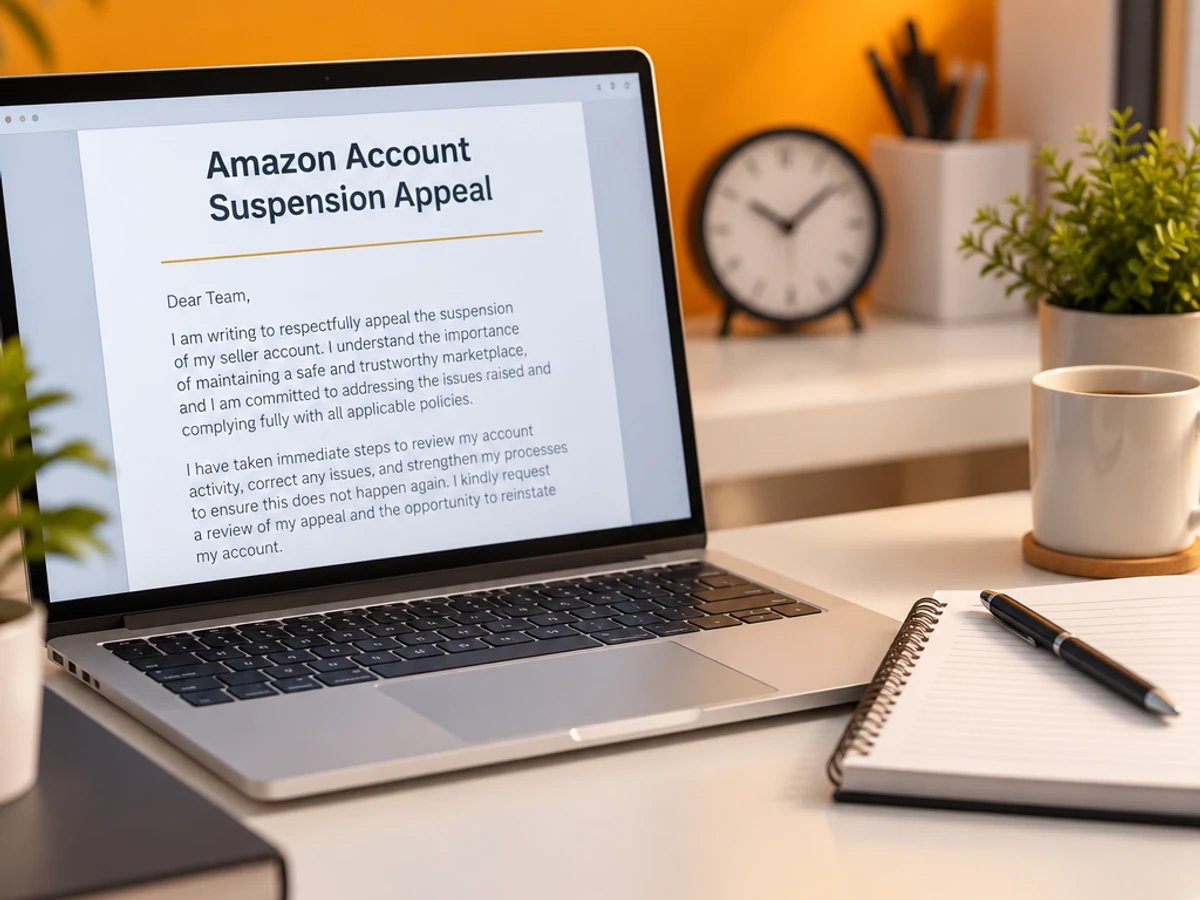

how to appeal an Amazon Section 3 suspension step by step | A Section 3 suspension isn’t the end of your business. This guide, updated January 2026, walks you through how to appeal an Amazon Section 3 suspension step by step with a realistic timeline: expect 3-7 days to prepare your appeal and 5-10 days for Amazon to review it.
What You’ll Learn: How to Appeal an Amazon Section 3 Suspension Step by Step in 2026
Section 3 refers to the termination clause in Amazon’s Business Solutions Agreement, reserved for the most serious allegations: fraud, deceptive conduct, or illegal activity.
By the end of this guide, you’ll know how to:
- Read a Section 3 notice and pinpoint what triggered it.
- Fix the underlying problem completely, not just describe it.
- Build a Plan of Action that moves beyond generic templates.
- Identify which evidence documents matter to Amazon’s reviewers.
- Know when and how to escalate if your first appeal is denied.
What you’ll need: Access to Seller Central, your original deactivation email, and any invoices, licenses, or business records connected to the flagged activity.
Why Appealing a Section 3 Suspension Matters in 2026
Section 3 enforcement is now the hardest category to reverse on Amazon. Industry analysis of 2025-2026 enforcement trends shows that Section 3 violations and IP complaints account for roughly 45 percent of permanent account closures.
The financial hit is severe. Marketplace enforcement data indicates Amazon deactivates an estimated 13,000+ seller accounts per month. Most never get reinstated, not because their violation was too severe, but because their appeal was too weak. Research on account suspension reinstatement shows Amazon typically holds your funds for up to 90 days during review.
A 2026 reinstatement guide warns that templates from 2022 no longer work because Seller Performance now uses LLM-assisted triage and rejects boilerplate within minutes. A specific, evidence-backed appeal determines reinstatement.
The Process at a Glance
| Step | Action | Time | Outcome |
|---|---|---|---|
| 1 | Confirm the notice and identify the exact trigger | 1-2 hours | Clear understanding of the real allegation |
| 2 | Fix the underlying root cause completely | 1-7 days | Issue is genuinely resolved, not just described |
| 3 | Draft the Plan of Action (POA) | 2-4 hours | One-to-two-page POA ready to submit |
| 4 | Gather and attach supporting evidence | 1-3 days | Evidence package proves the fix is real |
| 5 | Submit the appeal and prepare to escalate | 5-10 days wait | Appeal under review or escalated further |
Most sellers can complete steps 1-4 within 3-7 days. Amazon’s review typically adds another 5-10 days per round.
Step 1: Confirm the Section 3 Notice and Identify the Exact Trigger
What You’re Doing
Before drafting an appeal, you need to know exactly what Amazon believes you did wrong. Vague assumptions guarantee denials.
How to Do It
- Read the deactivation email carefully. A 2026 reinstatement guide notes the notice typically reads “Your seller account has been deactivated in accordance with section 3 of Amazon’s Business Solutions Agreement” with no specific policy cited, making Section 3 appeals harder to write than standard suspensions.
- Log into your Account Health dashboard and cross-reference any flagged ASINs, metrics, or performance notifications from the same timeframe.
- Rule out false positives. A 2026 Section 3 guide identifies the four most common triggers: related account linkage, review manipulation, identity verification failure, and authenticity complaints. Each requires different documentation.
- Write one clear sentence stating what Amazon is alleging. If you can’t state it clearly, you’re not ready to appeal.
Best Practices
- Treat the notice as a clue, not an insult. Save and timestamp the original email for escalation.
- Compare ambiguous language against known enforcement categories rather than guessing.
Common Mistakes
Sellers respond to the symptom (a removed listing) rather than the actual Section 3 allegation (deceptive conduct), guaranteeing denial on the first attempt.
What Done Looks Like
You can state in one sentence exactly which Section 3 category Amazon is alleging and which account activity triggered it. For a more detailed walkthrough, see Understanding Amazon’s Section 3 Appeal | PDF.
Step 2: Fix the Underlying Root Cause Before You Appeal
What You’re Doing
Amazon will not reinstate your account based on promises. The underlying problem must be genuinely resolved before submission.
How to Do It
- Take corrective action matching your trigger: separate linked accounts, remove flagged listings, update KYC or banking information, or secure authorized-distributor invoices. A practical guide recommends correcting the underlying issue completely before submitting, whether separating accounts, removing listings, or updating verification information.
- Document each fix with dates. Vague claims get rejected.
- If a third-party agency caused the violation, address the operational control gap directly. Blaming the agent alone won’t work.
- Confirm the fix is stable before drafting the POA.
Best Practices
- Keep dated proof of every corrective step.
- For supply chain or authenticity concerns, obtain clean invoices or letters of authorization before submission.
What Done Looks Like
Every element Amazon could question about your account’s compliance has been corrected and documented, not just promised.
Step 3: Write the Section 3 Plan of Action
What You’re Doing
The Plan of Action (POA) is the single document determining whether your account is reinstated. It must be structured, specific, and free of boilerplate.
How to Do It
- Open with a concise Root Cause statement naming the exact issue in your own words, not copied template phrases.
- Follow with Corrective Actions already completed. Experts agree the POA is the single document Amazon uses to decide reinstatement, requiring three specific elements; missing or vague treatment of any one is the most common rejection reason.
- Add a forward-looking Preventive Measures section specific enough to demonstrate genuine process change, not vague compliance commitments.
- Keep the full document to one or two pages in plain, professional language, with no emotional appeals or unnecessary admissions.
Example
| POA Section | Weak Example | Strong Example |
|---|---|---|
| Root Cause | “We made a mistake with our account.” | “Two seller accounts were linked due to shared device access by a former contractor.” |
| Corrective Actions | “We fixed it.” | “Device access was revoked, banking details updated, and a notarized ownership statement submitted on January 15, 2026.” |
| Preventive Measures | “We will be more careful.” | “A written access-control policy now restricts account logins to two verified company devices with monthly audit logs.” |
Common Mistakes
Submitting generic, downloaded POA templates is one of the fastest ways to get denied. Templates from 2022 no longer work because Seller Performance uses LLM-assisted triage rejecting boilerplate within minutes. A second mistake is treating corrective actions and preventive measures as identical when Amazon expects them distinct.
What Done Looks Like
You have a one-to-two-page document with three clearly labeled sections, each written in specific, verifiable language tied to your actual case.
Step 4: Gather and Attach Supporting Evidence
What You’re Doing
A strong POA is only as credible as the evidence behind it. Amazon’s reviewers are trained to look for documentation proving the fix, not just describing it.
How to Do It
- Collect only evidence directly proving corrective actions: clean invoices, letters of authorization, lab test results, updated listings or labels, and matching KYC or banking records.
- An attorney-authored guide recommends attaching only evidence proving fixes: clean invoices, letters of authorization, lab tests, updated listings and labels, network separation documentation, and matching KYC and banking records.
- For related-account or identity issues, consider sworn or notarized statements breaking incorrect linkage assumptions.
- Label every attachment clearly and reference it by name in the POA text so reviewers never guess what a document proves.
Best Practices
- Submit documents in standard formats (PDF, clear photos) rather than cropped screenshots.
- Avoid flooding the case with irrelevant paperwork. A tight, relevant evidence set reads as more credible.
What Done Looks Like
Each claim in your POA has at least one corresponding piece of clearly labeled evidence attached.
Step 5: Submit the Appeal and Escalate If Denied
What You’re Doing
This is where you formally submit your case through Seller Central and escalate if necessary.
How to Do It
- Submit the appeal through Seller Central’s designated form, attaching the POA and evidence package together.
- Track your timeline realistically. According to a 2026 guide, a Section 3 closure typically has a first response window of 5-10 days, with full resolution taking weeks to months.
- If the first appeal is denied, request escalation rather than resubmitting the same letter. The escalation path for denied Section 3 cases is executive escalation or legal review.
- If your case stalls after multiple rejections or involves a large frozen balance, engaging a specialist firm like The Appeal Guru often changes outcomes. Professional reinstatement help becomes valuable for Section 3 cases, repeat suspensions, multiple rejected appeals, or large frozen balances.
Common Mistakes
Resubmitting an identical POA after denial almost never works. Amazon’s reviewers flag repeat submissions as low-effort. Going silent for weeks between escalation attempts also slows an already lengthy process.
What Done Looks Like
Your appeal is formally logged in Seller Central, you know your expected response window, and you have a clear next escalation step mapped out for denial.
What to Do After Your Appeal Is Submitted
Phase 1: Monitor and respond fast. Check Seller Central daily during the first response window and reply to any follow-up requests within 24 hours. One documented case shows that completion of a requested video review led directly to suspension lift.
Phase 2: Plan around frozen funds. Assume payouts may remain held for up to 90 days even after reinstatement, and build short-term cash flow around that reality.
Phase 3: Harden your account against repeat suspension. Sellers suspended once are statistically more likely to face it again because the root cause was usually systemic. Treat preventive measures as permanent policy, not a one-time fix.
Resources You’ll Need
| Resource | Role | Required/Recommended | Price |
|---|---|---|---|
| The Appeal Guru | Bespoke Plan of Action drafting, invoice verification, and escalation support for Section 3 cases | Recommended for repeat or denied appeals | $1,495 per appeal |
| Amazon Seller Central | Submitting appeals, tracking Account Health, viewing notices | Required | Free |
| Amazon Business Solutions Agreement | Source text defining Section 3 terms and seller obligations | Required reading | Free |
| Amazon Brand Registry | Supports authenticity and IP-related evidence for brand owners | Recommended for brand owners | Free with eligible trademark |
The Appeal Guru provides bespoke Plan of Action letters, Amazon invoice verification, brand registry support, listing reinstatement, and FBA partnership solutions. Services are offered at a flat $1,495 per appeal, with repeat appeals on the same case included at no extra charge, and a 50-70 percent refund guarantee backed by a Feefo Platinum Trust Award. See also, see How to Prevent an Amazon Account Suspension in 2026.
Common Plateaus and How to Break Through
Plateau: The appeal keeps getting denied with the same generic response
Likely cause: The POA is treated as boilerplate by Amazon’s automated triage because it lacks specific dates, names, and document references.
Fix: Rewrite the Root Cause and Preventive Measures sections with concrete details tied directly to your account.
Plateau: Funds remain frozen even after reinstatement
Likely cause: Payout holds are a separate process from account reinstatement and run on their own timeline.
Fix: Plan cash flow assuming Amazon typically holds funds for up to 90 days. Follow up specifically on the payout hold once the account is active.
Plateau: Repeated escalation requests go unanswered
Likely cause: Standard Seller Support cannot handle Section 3 cases beyond the first one or two rounds.
Fix: Escalate formally through Executive Seller Relations or legal-style demand letters.
Plateau: You suspect the suspension is a false positive from account linkage
Likely cause: Shared devices, IP addresses, or payment details triggered Amazon’s related-account detection incorrectly.
Fix: Address the specific operational gap directly. Appeals must specifically address the operational control gap that allowed the flagged behavior, rather than simply denying the connection. For more troubleshooting advice, see how to appeal for section 3 violation? pls kindly help.
Conclusion
Knowing how to appeal an Amazon Section 3 suspension step by step in 2026 comes down to five disciplined moves: confirm the exact trigger, fix it completely, write a specific three-part Plan of Action, attach proof instead of promises, and escalate decisively if the first response fails. Section 3 cases are unforgiving of vague language, but they are winnable when the appeal matches the seriousness of the allegation.
Key Takeaways
- A Section 3 suspension can be reversed with a root-cause-first approach and verifiable evidence, not generic apologies.
- The POA’s three sections (Root Cause, Corrective Actions, Preventive Measures) are judged individually; weakness anywhere sinks the whole appeal.
- Confirm your exact trigger today and begin corrective steps before drafting your appeal.
FAQ
How do you appeal an Amazon Section 3 suspension step by step in 2026?
Confirm the exact wording of the Section 3 notice and identify the real trigger. Fully correct the underlying issue and document every step. Write a specific one-to-two-page Plan of Action (POA) covering Root Cause, Corrective Actions, and Preventive Measures, attaching verifiable evidence. Submit your appeal through Seller Central, and if denied, escalate through executive channels or consider engaging a specialist appeal service.
What exactly is a Section 3 suspension on Amazon?
Section 3 refers to the termination clause of Amazon’s Business Solutions Agreement, reserved for alleged fraudulent, deceptive, or illegal conduct, distinct from routine performance-metric suspensions.
How long does a Section 3 appeal take to resolve?
Expect a first response window of 5-10 days, with full resolution taking weeks to months, and an escalation path of executive escalation or legal review if denied.
Should I write the Plan of Action myself or hire a professional?
Simple, first-time suspensions can often be handled independently. Professional reinstatement help becomes valuable for Section 3 cases, repeat suspensions, multiple rejected appeals, or large frozen balances.
What should a Plan of Action include for a Section 3 case?
Amazon expects three distinct elements: a clear Root Cause, specific Corrective Actions already taken, and forward-looking Preventive Measures. Missing or vague treatment of any one is the most common reason appeals are rejected.
Why do most Section 3 appeals get denied on the first attempt?
Most denials trace back to generic language rather than the severity of the violation. Amazon deactivates an estimated 13,000+ seller accounts per month, most never reinstated not because the violation was severe, but because the appeal was weak.
What happens to my funds during a Section 3 suspension?
Funds are typically held separately from the reinstatement decision. Amazon typically holds existing funds for up to 90 days during review, so reinstatement does not always mean immediate access to frozen payouts.
Can a Section 3 suspension happen to an honest seller by mistake?
Yes, false positives occur, particularly around account linkage or identity verification. Appeals need to directly address the operational control gap that allowed the flagged pattern, rather than simply asserting innocence without explanation.
This guide was compiled from publicly available Amazon seller policy information and current 2026 industry reporting on Section 3 enforcement trends. Individual case outcomes vary based on account history, evidence quality, and Amazon’s internal review discretion. It is intended as educational information, not legal advice.