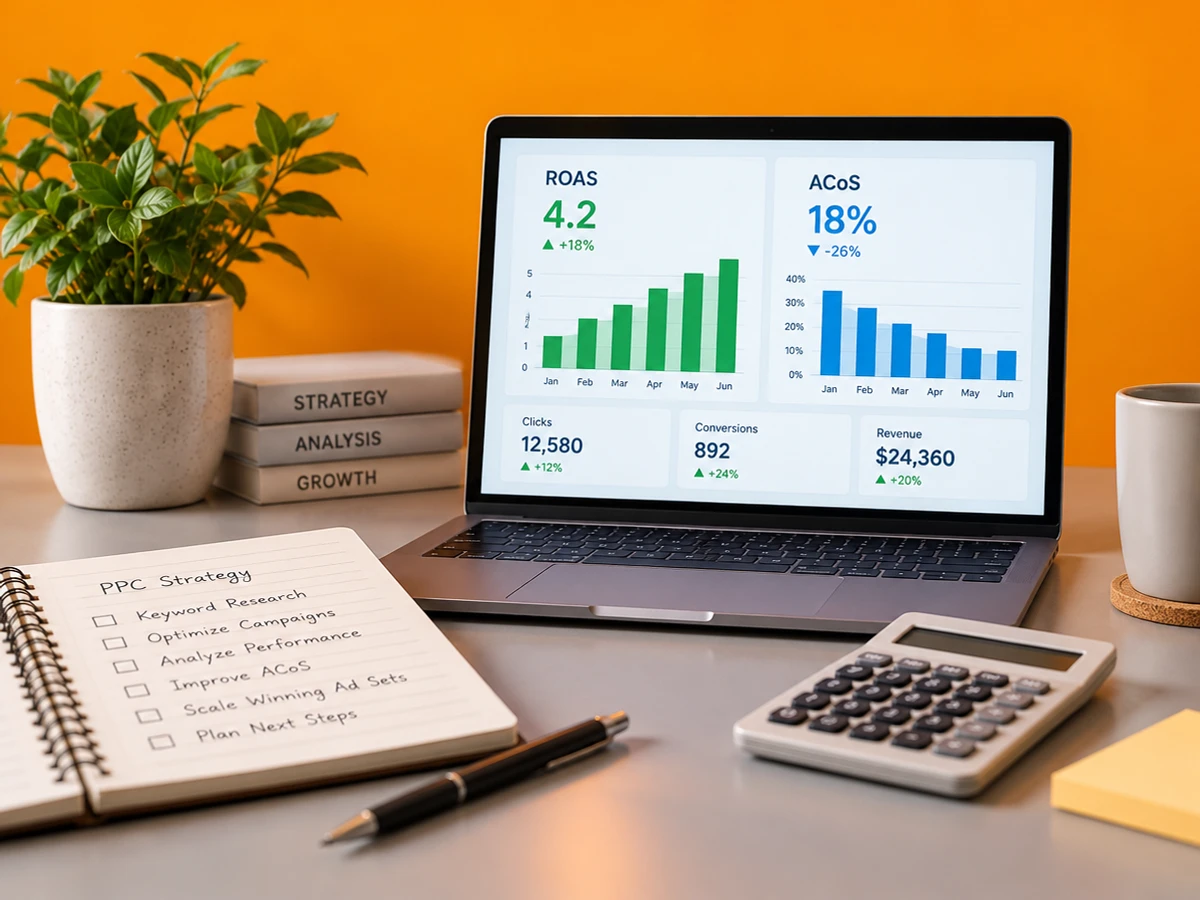
is Amazon PPC worth it for small sellers with limited budgets | Is Amazon PPC worth it for small sellers with limited budgets in 2026? Yes, but only under specific conditions: a product margin above roughly 25%, a listing that converts at or above its category average, and enough cash flow to sustain at least $500 to $1,500 per month for 60 to 90 days before judging results. For sellers who meet those conditions, Amazon Pay-Per-Click (PPC) advertising remains one of the few growth levers that can move a new listing from page five to page one within weeks rather than months.
The answer depends less on whether PPC “works” in the abstract and more on whether a seller’s unit economics, inventory, and account health can absorb the cost of testing. Industry data from 2026 puts average **cost-per-click (CPC)** at roughly $1.10 to $1.22 across all categories, a figure that has climbed steadily since 2020.
The small sellers who struggle most with Amazon PPC are not the ones who spend too little. They are the ones who spend without a floor, a ceiling, or a plan for what happens if the account gets flagged mid-campaign.
Is Amazon PPC Worth It for Small Sellers With Limited Budgets?
For most small sellers, **Amazon PPC is worth it only when the underlying listing and account are already healthy**. Advertising amplifies what already exists. It won’t fix a weak conversion rate, thin reviews, or an account near a performance violation. Research on 2026 CPC benchmarks found that small sellers in low-competition niches with CPCs between $0.80 and $1.20 and conversion rates above 15% can run profitable PPC campaigns from the first week.
When PPC Pays Off
- Healthy Margin: Small sellers see the clearest return when their product has a sufficient profit margin.
- Converting Listing: The listing must turn clicks into sales, performing at or above its category average.
- Stable Inventory: Maintain enough stock to avoid running out mid-campaign, which wastes ad-built ranking momentum.
When PPC Drains Cash Instead
The same research found that small sellers in high-competition categories such as supplements and electronics accessories often face launch CPCs that are unsustainable until they build organic rank, reviews, and listing quality. **Advertising without a strong foundation can quickly deplete budgets**.
- Margin threshold: A product needs roughly 25% gross margin or higher before PPC spend becomes sustainable rather than a break-even exercise.
- Conversion rate check: Listings converting below the category average waste clicks that a stronger listing would have turned into sales.
- Inventory runway: Running out of stock mid-campaign resets the ranking gains ads were paying to build.
- Account health: A account flagged for a policy issue can see advertising paused entirely, erasing weeks of optimization overnight.
Key Takeaway: PPC is worth it for small sellers with limited budgets only when margin, conversion rate, inventory, and account health are in place first.
How Much Does Amazon PPC Really Cost in 2026?
Amazon PPC runs on an auction model with no fixed price. **Average CPC has risen to roughly $1.10 to $1.22** across all ad formats, up from about $0.97 in 2023. Category matters enormously: a Books listing might pay under $0.40 per click, while a Health & Household or Electronics listing can pay well over $1.45.
Platform-wide **advertising cost of sale (ACOS)**, the ratio of ad spend to ad-attributed sales, sits at a median of roughly 38% across managed accounts in the first half of 2026. The spend-weighted average across larger portfolios runs closer to 30%.
| Category | Median ACOS (2026) | Average CPC | Conversion Rate |
|---|---|---|---|
| Books | 19% | $0.38 | 18.0% |
| Food & Grocery | 21% | $0.58 | 16.5% |
| Beauty & Personal Care | 24% | $1.18 | 15.2% |
| Pet Supplies | 26% | $0.91 | 14.0% |
| Health & Household | 27% | $1.05 | 13.8% |
| Electronics | 29% | $1.45 | 9.5% |
| Clothing & Apparel | 42% | $0.72 | 8.6% |
Benchmark data compiled across multiple 2026 datasets shows that category spread is wider than the platform average itself. A flat “average CPC” is nearly useless for budgeting unless you know your own category. **Category-specific benchmarks are essential for accurate ROI calculations**.
A $2.00 click that converts at 15% costs you $13.33 per sale. A $0.50 click that converts at 3% costs you $16.67 per sale. Cost per acquisition, not cost per click, is the number that determines whether PPC is worth it.
Key Takeaway: Small sellers calculating Amazon advertising ROI should benchmark against their specific category, not the platform-wide number.
Budget Amazon Advertising Strategies for Small Sellers
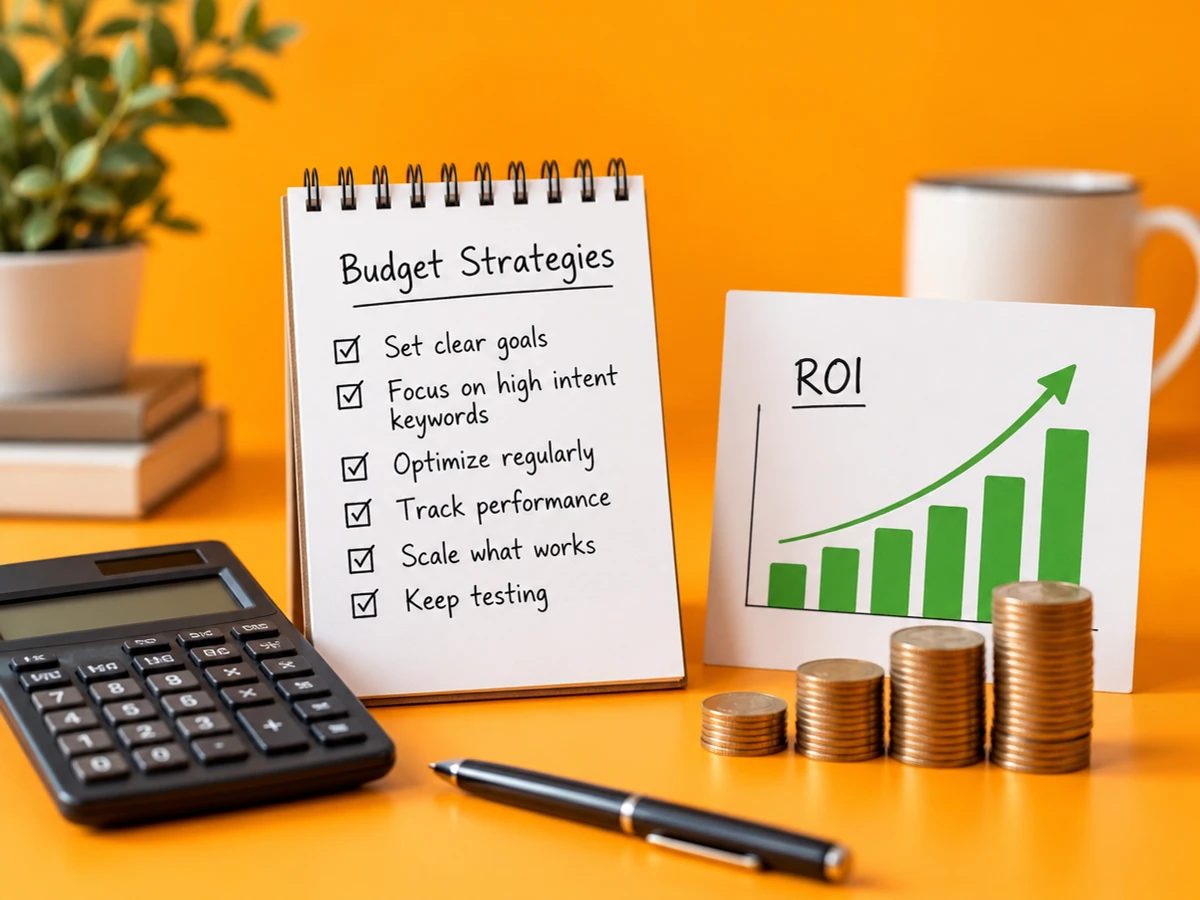
Small sellers who build sustainable PPC programs plan their budgets before they spend. **Most sellers need at least $20 to $50 per day per campaign** to gather enough click and conversion data to optimize within two to three weeks, according to 2026 Amazon PPC cost analysis.
Minimum Viable Budget
For a single product launch, a daily budget of $30 to $50 running for 14 to 21 days, totaling roughly $500 to $1,000, generates enough data to separate winning keywords from wasted spend. **This initial investment is critical for data collection**.
Monthly Validation Window
Small sellers testing whether PPC fits their business model should plan for $500 to $1,500 per month to validate performance before scaling spend. **This validation phase ensures profitability before significant scaling**.
| Budget Tier | Monthly Spend | Typical Goal | Best Fit For |
|---|---|---|---|
| Starter / test phase | $500 to $1,000 | Keyword discovery, initial rank | New ASIN launch, limited budget |
| Validation phase | $1,000 to $1,500 | Confirm profitable ACOS | Sellers past the first data cycle |
| Scaling phase | $1,500 to $5,000+ | Grow market share profitably | Proven listing, stable margin |
- Start narrow: Launch with 10 to 20 tightly relevant keywords rather than broad automatic targeting across a whole catalog.
- Set a daily cap, not a monthly guess: A $10 per day budget at a $1.00 CPC only buys 10 clicks daily, enough for testing but not for scaling.
- Track cost per acquisition: Compare total ad spend per unit sold against your break-even ACOS, not the raw cost per click.
- Reinvest selectively: Move budget toward keywords with ACOS below your margin threshold, and pause or lower bids on underperformers weekly.
- Protect cash reserves: Keep a buffer separate from PPC spend to cover inventory restocks.
Key Takeaway: Budget strategies should start narrow and data-driven, with $500 to $1,500 per month as a realistic validation range before committing to larger spend. For further reading, see Maisie Richardson-Sellers (@maisiersellers).
Amazon PPC Tips for Small Sellers: Avoiding Costly Mistakes
Many small sellers lose money on PPC not because advertising doesn’t work, but because of avoidable structural mistakes. The most damaging is **starting with too small a budget** spread across too many keywords, which produces data too thin to optimize from.
Tactical Mistakes to Avoid
- Underfunding the test window: A $10 per day budget works for initial keyword testing but cannot generate the data volume needed to scale confidently.
- Ignoring category benchmarks: Bidding as if every category behaves like Books, with its 18% to 20% conversion rates, leads to unrealistic expectations in higher-CPC categories like Electronics or Health & Household.
- Over-relying on automatic campaigns: Automatic targeting is useful for discovery, but it wastes spend on loosely related search terms if left unmanaged for weeks.
- Chasing impressions over conversions: Sponsored Display CPCs have risen sharply, and chasing visibility without conversion data can drain a limited budget fast.
Account Health Mistakes That Hurt PPC Performance
Advertising doesn’t exist in isolation from account health. Amazon’s enforcement systems in 2026 are increasingly automated, and industry data shows roughly 14% of Amazon seller accounts faced some form of suspension or deactivation action in the first quarter of 2026, up from an estimated 10% in 2024. **Proactive account health monitoring is crucial**.
- Compliance Flags: Restricted keyword bidding and advertising policy violations can themselves trigger compliance flags. That’s one reason ongoing account protection guidance recommends pairing advertising oversight with catalog compliance.
- Suspension Impact: Campaigns stop serving the moment an account is suspended, and funds already allocated to active bids can sit frozen during the investigation.
- Expert Reinstatement: The Appeal Guru helps sellers navigate suspensions and complex reinstatement processes so that advertising investment isn’t wiped out by an account-level issue. With bespoke Plans of Action, invoice verification support, and a Feefo Platinum Trust Award, the team works to get sellers back to selling, and back to advertising, as quickly as possible.
Key Takeaway: Account-health risk is a direct threat to ad spend. Sellers who advertise aggressively without monitoring compliance risk having their campaign budget frozen mid-cycle.
When Is Amazon PPC Not Worth It for Small Sellers?
Amazon PPC isn’t worth it for every small seller, and spotting warning signs early saves budget. **Sellers with margins under 20%, unoptimized listings, or unstable inventory** typically see PPC spend disappear without a proportional sales lift.
Red Flags Before Launching a Campaign
- Thin or negative margin: If gross margin sits below roughly 20% to 25%, even a well-run campaign at platform-average ACOS can push the product into a loss.
- Poor listing fundamentals: Weak images, thin bullet points, or a review count far below competitors mean clicks won’t convert, regardless of ad spend.
- Unstable account health: An account near a performance threshold or carrying unresolved policy notifications is not a safe candidate for scaling ad spend.
- Inventory uncertainty: Sellers unsure they can restock within four to six weeks risk wasting ranking gains the moment they go out of stock.
What to Do Instead
Sellers who recognize these red flags are usually better served by pausing PPC, fixing the listing or account first, and reintroducing advertising once the foundation is stable. 2026 seller data shows that only 33% of individual sellers and SMBs report a profit margin above 20%, compared to 47% of enterprise brands. **Prioritizing foundational health saves budget**.
The majority of Amazon sellers, 64%, are small businesses earning under $100,000 per year in revenue. That’s exactly the segment where a single bad PPC month can threaten cash flow for the entire quarter. **Strategic pausing can protect overall business health**.
The majority of Amazon sellers, 64%, are small businesses earning under $100,000 per year in revenue, which is exactly the segment where a single bad PPC month can threaten cash flow for the entire quarter.
Key Takeaway: Amazon PPC isn’t worth it when margin, listing quality, or account stability are compromised. Fixing those fundamentals first protects both the ad budget and the business.
Conclusion
For sellers with healthy margins, converting listings, and stable accounts, Amazon PPC is worth it in 2026, with a realistic starting budget of $500 to $1,500 per month and patience through the first 14 to 21-day data cycle. For sellers missing those conditions, PPC often amplifies a problem rather than solving one. **Strategic preparation is key to PPC success**.
- Benchmark against category, not platform average: A $1.20 average CPC means little if your category runs at $0.40 or $2.00.
- Start narrow and data-driven: $500 to $1,000 launch budgets with 10 to 20 keywords beat broad, unmanaged spend.
- Track cost per acquisition over cost per click: It’s the metric that actually determines Amazon advertising ROI.
- Protect account health alongside ad spend: A suspension freezes advertising entirely and can erase months of PPC progress overnight.
- Get expert help before a suspension derails your budget: The Appeal Guru offers fast, bespoke reinstatement support so small sellers can get back to advertising and selling with confidence.
FAQ
Is Amazon PPC Worth It for Small Sellers in 2026?
Yes, provided they have gross margins above roughly 25%, a listing converting at or above the category average, and stable inventory. 2026 cost data suggests most small sellers should plan for $500 to $1,500 per month to validate PPC performance before scaling. **Meeting these conditions is crucial for a positive return on investment**.
What is the minimum budget for Amazon PPC with limited funds?
Most sellers need at least **$20 to $50 per day per campaign** to gather enough click and conversion data to optimize within two to three weeks. For a single product, that works out to roughly $500 to $1,000 over 14 to 21 days.
What is a good ACOS for a small seller in 2026?
A good ACOS is any figure below your break-even ACOS, which equals your profit margin before advertising costs. Platform-wide, the median managed account ran a 38% ACOS in the first half of 2026. **Your specific product margin determines what counts as a “good” ACOS**.
Does Amazon PPC help small sellers rank higher organically?
PPC can accelerate organic rank by driving the sales velocity and review volume Amazon’s algorithm rewards, but it can’t substitute for a converting listing. **PPC acts as an accelerator for an already strong listing**.
Why does my Amazon PPC stop working after an account suspension?
Campaigns stop serving immediately when an account is suspended, and funds tied up in active bids can remain frozen until the investigation resolves. Pairing advertising with proactive account-health monitoring, and having a fast reinstatement partner like The Appeal Guru on call, protects both selling privileges and ad budget.
Which Amazon categories are cheapest for small sellers to advertise in?
Books, Food & Grocery, and Crafts tend to offer the lowest CPCs and ACOS. Books average around $0.38 per click with a 19% ACOS, compared to Electronics at roughly $1.45 per click and a 29% ACOS.
How do small sellers calculate Amazon advertising ROI?
Amazon advertising ROI is best measured through cost per acquisition and ACOS relative to gross margin, not raw cost per click. A higher CPC that converts well can produce a lower cost per sale than a cheaper click with a weak conversion rate. **Focus on profit per sale, not just click cost**.
Should a small seller pause PPC during a listing or account suspension?
Amazon pauses advertising automatically when an account or listing is suspended, so no action is needed to stop spend. Sellers should still focus immediately on resolving the suspension with a clear Plan of Action, the kind of bespoke support The Appeal Guru provides. **Swift resolution is key to minimizing lost ad momentum**.
This article synthesizes publicly available 2026 Amazon advertising benchmark data, industry seller statistics, and account-suspension research current as of November 2026. Figures such as CPC, ACOS, and seller revenue distribution vary by data provider, time period, and account sample size. Treat industry averages as directional benchmarks rather than guarantees, and consult your own account data before setting a PPC budget. The Appeal Guru provides reinstatement and account-management guidance and does not provide legal advice.